Open a Business in Germany as a Foreigner
Here is a guide on how to open a company in Germany as a foreigner. For business registration services in Germany, please contact us.

Our local agents specialize in helping foreign investors who decide to open businesses in Germany. However, we can also provide consulting services, which is why this article will concentrate on what it entails to run a company in this country. We will review the costs associated with having an enterprise, as well as what differentiates Germany from other countries in terms of doing business.
Company formation in Germany from EUR 1,250
State fees and the lawyer’s or service provider’s fee apply.
| Quick Facts | |
|---|---|
| Fastest way to start a business in Germany as a foreigner | Registering a private limited company (GmbH). |
Time frame to register a business in Germany | Approx. 1 month. |
Composition of the business registration costs | – document preparation and notarization, – registration fees, – licensing fees. |
| Maintenance costs | – office costs, – utilities, – accounting fees. |
| Special costs/fees to consider (if any) | License renewal may attract the payment of periodic fees. |
| Bureaucracy | Germany has a medium bureaucracy level compared to other European countries. |
| Availability of online business administration services (YES/NO) | Yes, some actions can be completed online. |
| Corporate tax rate | 15%, however, additional charges apply (solidarity surcharge, municipal trade tax). |
| Particularities of the workforce | A mix of German and foreign workers, skilled personnel with vocational training and higher education. |
| Personal income tax | 0% to 45% depending on the income. |
| Social contributions to pay as an employer | An employer must pay a total social contribution of approximately 21% per employee (2026 rates, plus accident insurance and levies). |
| Best performing industries | – automotive, – mechanical engineering, – electrical, – chemical. |
| Possibility to register a business remotely in Germany (YES/NO) | Yes, with the help of our specialized agents. |
| Restrictions on foreign investments (if any) | No, however, the State screens foreign investors in sectors like defense and cybersecurity. |
| Why open a business in Germany? | – access to national incentives, – access to EU funds, – strong startup environment, – good business culture. |
Before opening a company in Germany, our local company formation specialists can also guide you in choosing a suitable structure based on the size and type of activity you plan to undertake.
What are the costs to consider when setting up a business in Germany?
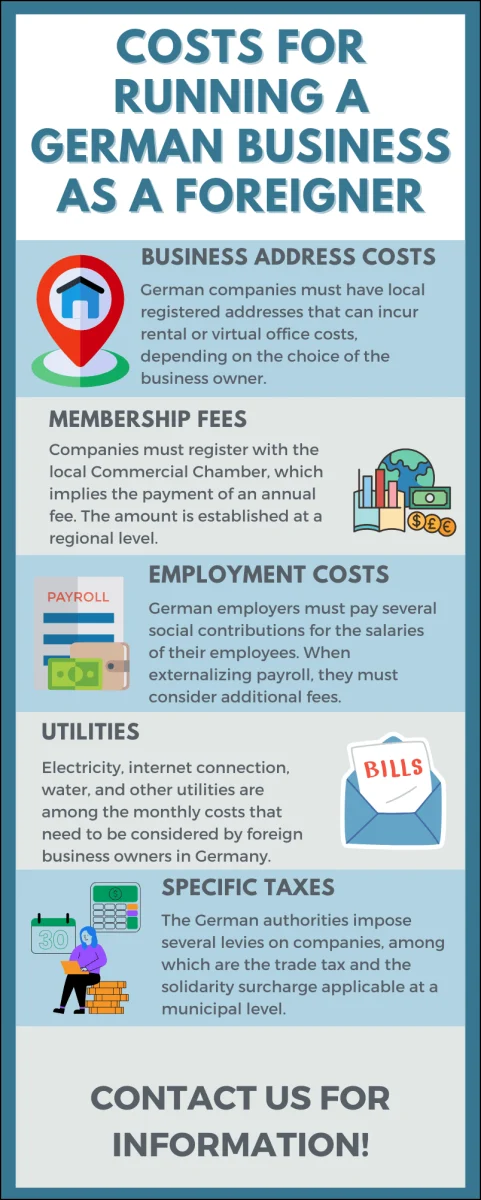
Starting a business in Germany implies gaining access to the largest European and EU market in terms of clients and/or consumers. However, a part of the profits must be allocated to the administration of your enterprise. Here is what you should consider:
- the business address costs, which can include office rental, virtual address contract, or maintenance costs if you decide to buy the facilities in which you run the activities;
- the commercial chamber membership, which is based on a fee paid at the regional level;
- employee salaries, for whom, as an employer, you must pay social contributions;
- accounting fees, which depend on the type of structure you use when you open a business in Germany as a foreigner;
- specific taxes you need to pay in Germany, among which are the trade tax, which is levied by the municipality in the city where the business is registered, and a solidarity surcharge.
In numbers, these costs would imply:
- a few hundred euros to a few thousand euros for the business address, depending on the city you register your company (the virtual address is the cheapest option, as you can obtain it for EUR 150 to EUR 400 per month);
- commercial chamber membership fees range from EUR 64 in Berlin and can reach around EUR 200 (payable per year);
- accounting fees vary from EUR 50 per month for small businesses to hundreds of euros for large ones with complex operations;
- the trade tax is levied at a base rate of 3.5% to which a municipal multiplier is added (it ranges from 200% to 580% based on the city);
- the solidarity surcharge is currently 5.5%.
Running a business in Germany is not cheap; however, the advantage of operating an enterprise here often surpasses these costs.
Here is also our infographic on this topic:
How do I choose the best business form for my German company?
A useful thing you can do is to consult a German company formation firm right after you decide that you want to launch a business here. Do your research on the market, set the budget, and then discuss your options with a professional. The most common things to consider are:
- the size of your business;
- the capital you have;
- the city you will operate in.
Most foreign entrepreneurs start small, which gets them confused as they want to decide between the sole trader and a private limited liability company. In this case, you should also consider taxation.
What are the immigration formalities I should be aware of when moving to Germany as a businessman?
If you have decided to also move to Germany when starting your business, there are, in fact, specific immigration procedures you need to follow. Here is what you need to consider:
- if you are an EU citizen, you need to register with the local municipality, but pay attention to the registration deadline, which is only 14 days after you move into your new home;
- if you are a non-EU citizen, you must apply for an entry visa and residence permit (nationals of e.g. the USA, Canada, the UK, Japan or Australia may enter visa-free and apply for the residence permit in Germany), and then you must also register with the local registration office within the same 2-week timeframe.
You also need to consider enrolling for taxation, social security, and healthcare.
Are there any language requirements that I need to consider?
At least an A1 level of German is recommended, as businesspeople here appreciate people who speak their language. However, you can also do fine with English in the German business market.
What are the documents that I must translate to open a company in Germany as a foreigner?
The documents you need to have translated and authenticated are the official papers you will use in the registration process. They can be:
- your passport;
- the Certificate of Registration of your company (if you start the business by expanding an existing one);
- the Articles of Association and other constitutive documents for an existing company;
- diplomas, qualifications certificates, if you start your business as a sole entrepreneur.
What are the costs for translating official documents in Germany?
Prices vary based on the number of pages and the city in which you register the business. However, you can expect average prices of 40 to 80 euros as a total.
Is it difficult to have a business in Germany?
If we were to give a detailed answer, here is what you should expect:
- Germany is one of the strongest economies in the world, and two of the key factors contributing to its success are the strong regulations applicable to businesses and political stability;
- bureaucracy here is higher compared to other European countries; however, it contributes to increased business protection;
- access to skilled labor force, thanks to the educational system, which encourages vocational training and higher education studies, will help you ease the challenges of finding employees;
- English is well spoken in large German cities; as such, language barriers are low if you decide to open a business in Germany as a foreigner.
Germany is also among the 10 countries in the world investing in innovation, especially in sectors like IT, pharmaceuticals, and research and development. Innovation is also the main job-creating sector in the country.
Here is also our video on this subject below:

Why open a business in Germany as a foreigner?
While it is not one of the easiest countries to do business in, Germany is definitely unique when it comes to having an enterprise here. Here are some of the reasons to decide on it as your future business destination:
- the access to a wide variety of incentives and funds offered by the German government compared to other countries, as well as access to EU programs;
- the encouragement of startup businesses, so you can start low and build a strong company;
- the transparent legal environment;
- the developed inbound and outbound transportation network, as punctuality is one of the strengths of German business culture;
- the quality of the goods manufactured here is renowned all over the world.
Even if the company formation process in Germany is more complex, running a business here will definitely overcome this inconvenience, thanks to the reasons above. So, if you decide to set up a business, do not hesitate to contact us.
Marco Rössel, Attorney at Law · 8 October 2026