Open an IT Company in Germany
Opening an IT company in Germany implies specific registration procedures. Our German company formation agents may assist you with details.

If you want to open an IT company in Germany, there are several ways to do that. Below, our local experts explain the steps and offer tailored guidance while going through each of them.
What are my options to start an IT business in Germany?
You have two options:
- to register a company, a private limited liability company (GmbH);
- to operate as a sole trader.
Is remote IT company registration available with you?
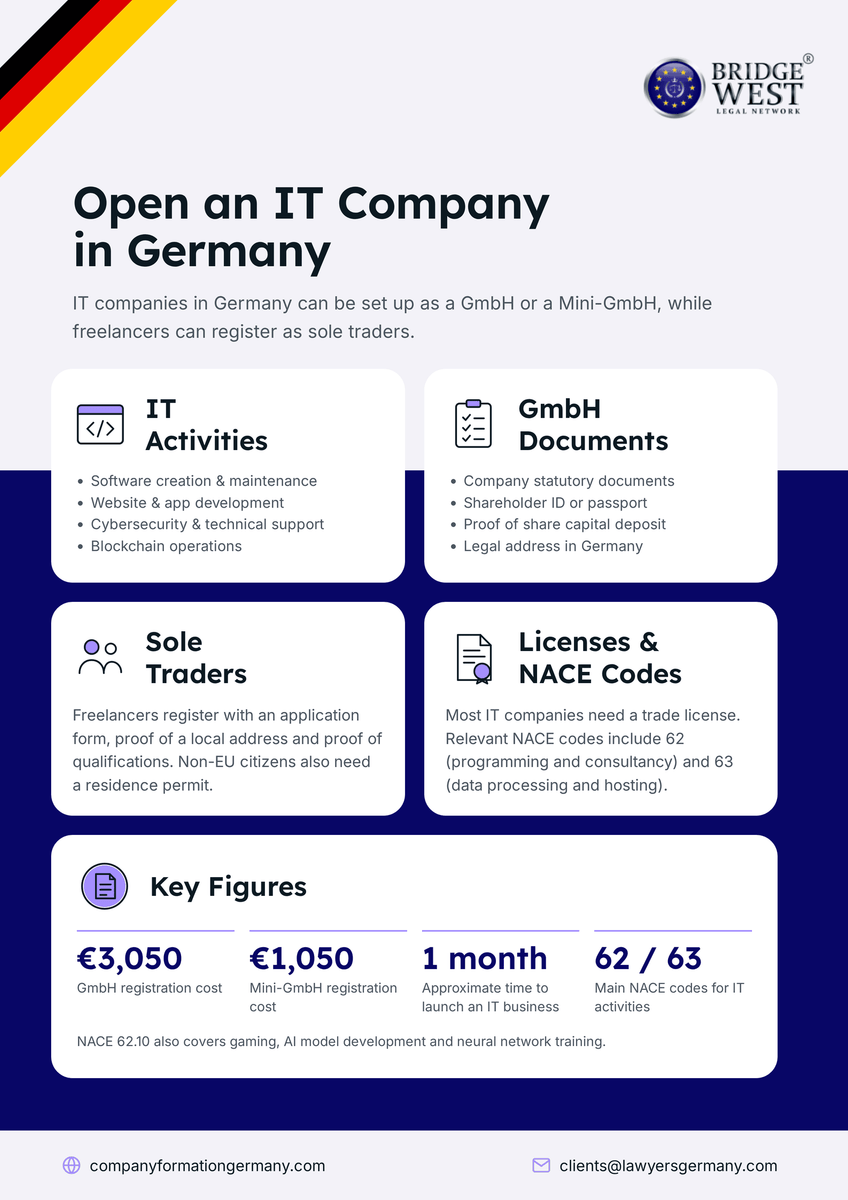
Yes, we can assist with the registration of a mini-GmbH for the price of EUR 1,250 or a GmbH for the price of EUR 3,050.
Are there any special requirements to comply with if I want to open a German IT company as a foreigner?
If you want to operate as a freelancer from Germany, you must obtain a residence permit if you are a non-EU citizen. The same applies (residence permit for self-employment under Section 21 Residence Act, unless you manage the business from abroad) if you decide to incorporate a company or expand an existing enterprise in Germany.
What are the steps to open an IT company in Germany?
Starting a company in Germany requires a standard procedure. Our consultants in company formation in Germany can explain you step by step the process of business registration with the local authority.
What documents are required to start an IT business in Germany?
Local and foreign investors who want to set up IT companies in Germany must prepare a set of documents, in accordance with the legal entity used for registration.
When starting the enterprise as a sole trader, an application form alongside proof of local address and qualifications will be required.
When incorporating a private limited liability company, the following will be requested by the German Trade Register:
- the company’s statutory documents;
- the ID/passport of the shareholder;
- a bank account statement indicating the deposit of the share capital;
- proof of the legal address in Germany.
Our German company formation specialists can assist with the preparation of the documents required for incorporating any legal form.
Do IT activities in Germany require business licenses?
Yes, most German companies operating in the IT sector will need to register their trade (Gewerbeanmeldung); no special license is required.
A useful detail to consider when setting up an IT company is that local companies can also hire skilled foreign employees for whom IT work permits can be obtained.
What are the NACE codes for IT activities in Germany?
There are several NACE/WZ codes under which an IT company can operate in Germany, as follows:
- Section 62, Computer programming, consultancy, and related information service activities;
- Section 62.10, Gaming operations, custom machine learning models, training neural networks, or programming generative AI systems;
- Section 63, Information service activities, data processing and hosting.
NOTE: These are some examples of NACE codes for IT activities. Considering this sector is quite extensive, you can consult with our local specialists upon the registration of the company to select a more suitable code.
How long does it take to launch an IT business in Germany?
Approximately one month.
What activities can I undertake through an IT company in Germany?
Here are some of the most prolific IT activities you can develop through a company in Germany:
- software creation and maintenance;
- website and app creation;
- cybersecurity;
- technical support;
- blockchain.
All of them can be expanded to sectors like automotive, manufacturing, and industry.
Can I operate a German IT business abroad?
Yes, you can either offer your services to clients abroad, or you can expand it by setting up a presence in the desired countries. If you choose to operate within the European Union, the requirements are quite simple, considering Germany’s membership.
For more information on how to start an IT business, don’t hesitate to contact our specialists in company formation in Germany.
Marco Rössel, Attorney at Law · 8 October 2026